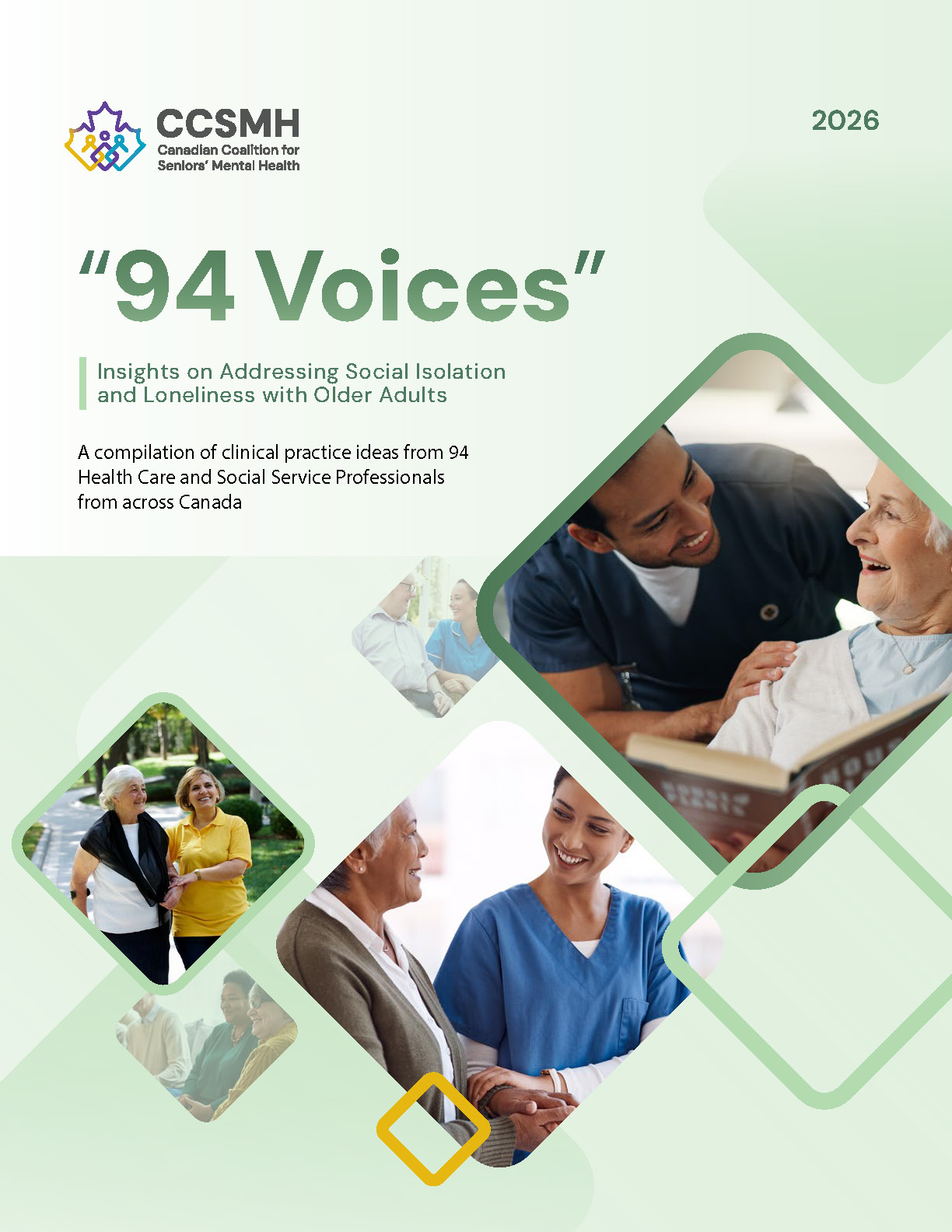
“94 Voices”: Insights on Addressing Social Isolation and Loneliness with Older Adults
 A compilation of clinical practice ideas from 94 health care and social service professionals from across Canada
When the Canadian Coalition for Seniors’ Mental Health (CCSMH) released the first National Clinical Guidelines on Social Isolation and Loneliness in Older Adults (SILOA) in 2024, the question shifted almost immediately. We had the why and the what. What we wanted to understand next was the how: what does it actually look like, in everyday clinical and community practice, to address social isolation and loneliness with the older adults in our care?
To find out, we went directly to the health care and social service professionals (HCSSPs) already doing the work.
In January 2026, we invited HCSSPs across Canada to share how they are addressing social isolation and loneliness in their everyday practice, so we could further share their stories through the CCSMH National Spotlight Campaign. The response was extraordinary: 94 professionals — nurses, physicians, social workers, recreation therapists, educators, occupational therapists, community workers, and administrators— contributed stories from nine provinces and a wide range of settings, from long-term care and primary care to community programs, rural outreach, and home visits.
The depth of what HCSSPs shared went well beyond what a single campaign could carry. The 94 Voices report is how we are bringing that collective wisdom together: a practical, deeply human companion to the Clinical Guidelines, and a portrait of social health in action.
Why this report, and why now?

Social isolation and loneliness are among the most significant public health challenges facing older adults in Canada, with documented links to dementia, depression, cardiovascular disease, and early mortality. The Clinical Guidelines on SILOA now exist to support clinical practice, but evidence only changes lives when it meets the realities of the people delivering care. What HCSSPs shared made one thing clear: across the country, they are already adapting, innovating, and noticing what others might miss. 94 Voices captures that wisdom so it can travel beyond a single team, ward, or community.
The national social media campaign’s organizing idea is the ripple effect: every action, big or small, contributes to broader change. This report is one way of amplifying those ripples.
What’s inside
The report is built around three sections:
- Practice Insights: what HCSSPs told us about how social isolation and loneliness actually present, including the practical, sensory, emotional, and systemic barriers behind what can look like simple “withdrawal.”
- Ten Practice Vignettes: concrete stories of action, each paired with the relevant recommendation from the Clinical Guidelines so readers can see exactly where evidence and practice meet.
- A Narrative Synthesis: the shared mindsets, strategies, and lessons that emerged across all 94 responses.
The vignettes clearly demonstrate how recommendations from the Clinical Guidelines are used in clinical practice— screening, assessment, social prescribing, social activity, leisure, physical activity, technology, psychological approaches, and reassessment. They include a social worker who helped a resident with amnesia rebuild her sense of self through a collaborative Identity Book (Recommendation 12 – Psychological therapies), an educator whose student-led Digital Access Training Team connected isolated, low-income seniors to devices and the internet (Recommendation 15 – Technology), a Men’s Shed that brought older men together side-by-side around hands-on projects (Recommendation 10 – Social Activity), a community walking group and coffee that gave two newly widowed men a way out of “the downward spiral of despair” (Recommendation 9 – Social Prescribing), and a recreation therapist who used the local library as a doorway back to community for a socially isolated client (Recommendation 9 – Social Prescribing).
How HCSSPs are doing this work
Four themes emerged consistently across the 94 responses:
- Practical entry points for social connection. HCSSPs rarely began with a formal “loneliness intervention.” Instead, everyday needs — a hearing aid, a ride to the grocery store, a scooter loan, a meal, or a technology question — became gentle doorways into deeper connection, and personal, low-barrier invitations mattered more than information alone.
- Recognizing that not all loneliness looks the same. Culture, language, identity, and life circumstance shape what isolation feels like and what kinds of connection feel safe — from culturally grounded spaces for Two-Spirit and Indigenous LGBTQQIA+ elders, to care in a person’s preferred language, to supporting family caregivers who are themselves a hidden isolated population.
- Moving from individual action to shared responsibility. Team-based noticing, cross-sector partnerships, and organizational support turn one HCSSP’s effort into a broader web of care.
- Connection as reciprocal. Many contributors described this work as professionally renewing and personally meaningful — a source of energy, not another drain on it.
“She wasn’t done. She just needed a doorway back in.”
— Owner/Programmer, Ontario
 Who this report is for

94 Voices is for anyone who supports older adults— in clinical care, community services, education, leadership, or volunteer roles. It is also for organizations and decision-makers thinking about how to embed social health into systems of care. The vignettes are designed to be adaptable, not prescriptive: practical examples of what is possible within real-world constraints of time, staffing, geography, and resources.
What’s next
This report is part of a larger CCSMH effort to build a more coordinated Canadian response to SILOA. It sits alongside the Clinical Guidelines on SILOA and our recent policy paper and Roadmap, which maps eight pathways for aligned action across sectors. Together, they offer the evidence, the practice wisdom, and the policy direction needed to keep moving forward.
Read the report, share it with colleagues, and bring its insights into your own practice.
Read the Full Report